Conformal IFSs at the Erdős Center

Last week, Balázs Bárány, István Kolossváry, and I organised a focussed workshop at the Erdős Center (Rényi Institute) in Budapest. The event was centred on recent progress on self-conformal and self-similar sets, in particular analytic iterated function systems and the Fourier decay of invariant measures.
The purpose of this blog entry is two-fold:
- To tell a little more about the event.
- To collect the notes, slides, and open problems that came out of it.
The Erdős Center Workshop
Motivation
Determining the size and complexity of fractal sets has a long history, with most results needing separation conditions that limit the amount of overlap. The landmark result of Hochman1 from 2014 showed that self-similar sets on the line satisfying the exponential separation condition (ESC) attain their ’expected’ dimension. The proof leans on the linear, (semi-)group structure of self-similar systems, and much of the later progress has used these underlying structures. The results were extended to higher dimensions2, to dimensions of measures such as the $L^q$ dimension3, and to Möbius maps, using their underlying linear structure by Hochman and Solomyak4. General self-conformal sets carry no such algebraic structure, so extending the theory to them looked hard.
Even with just the structure of $C^{1+\epsilon}$ maps, some things can still be said: With J. Angelevska and A. Käenmäki I proved a dichotomy5: a self-conformal set is either Ahlfors regular or has zero Hausdorff measure at its dimension, so self-conformal subsets of $[0,1]$ with positive measure attain their expected dimension. However, having positive Hausdorff measure is rather restrictive. An important breakthrough came from Rapaport6 in 2024, who showed that the ESC alone rules out dimension drop for analytic self-conformal systems on $\mathbb{R}$. Balázs, István, and I then showed that the ESC is (topologically) generic7 for such mappings. We obtained our results through constructing a dual IFS, an operator system obtained by lifting the original IFS to operators on analytic functions. At the time we did not realise that there was heavy overlap with classical work by Dolgopyat and the temporal distance function from dynamics8 (and have Amir Algom, Gaétan Leclerc, and Tuomas Sahlsten to thank for explaining the link to us!). In particular, our re-interpretation in terms of dual IFSs led to natural restatements of the UNI condition, which has been extensively used to prove Fourier decay of self-conformal measures9.
The workshop
In March 2026, the Erdős Center invited applications for focussed workshops, and we seized the chance to get everyone working on these topics in the same room. We prepared an application, were approved, and we set about organising the workshop.
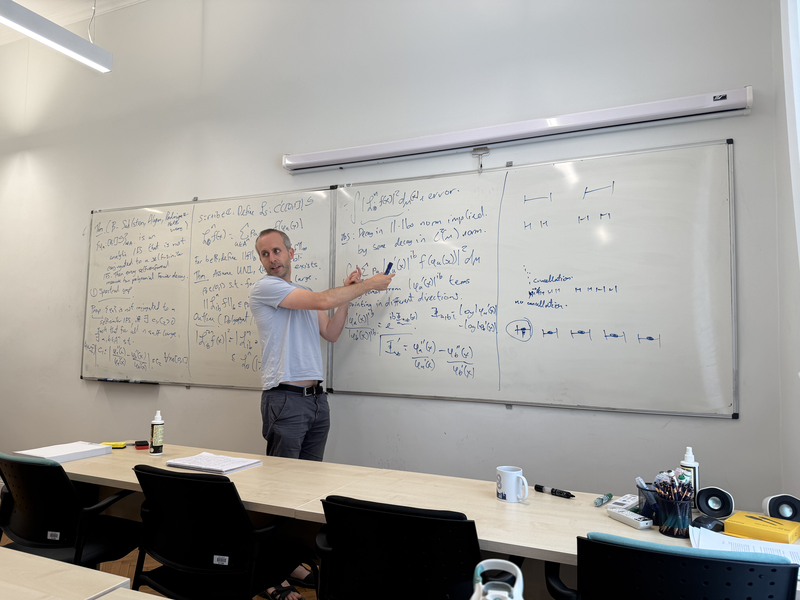
Simon Baker speaking at the Erdős Center.
We were given the centre for four days, as well as funding for the local costs of participants, and spent some time considering on how best to organise the time we had. While it is tempting to fall into the ‘same old’ habit of scheduling the entire week full of talks, we opted to only have a few, held over the first two days. At the end of the second day we held a “problem session” where people could present problems they were interested in and we jointly discussed how to spend the next few days. Having had this time open, we left it at impromptu discussions, as well as hearing talks on more ‘basic’ content in which some of the participants were experts in.
We were a little afraid that the lack of structure would be detrimental and would not encourage active participation. These fears proved unfounded. Helped by the small size of the gathering and its narrow scope, interactions were lively: many questions during the talks, and long discussions between them. We had the flexibility to extend talk or have follow ups; and when people asked for further talks on specific topics, we could use the free days for informal seminars on them. Several collaborations began during the event, and everyone seemed to leave with new ideas.
Overall, I believe this was one of the most effective workshops I have been involved in: no talks were skipped, and the thematic focus meant everyone listened and participated actively in every talk, something that simply does not happen at larger conferences with their many talks across a wide range of topics.
Of course, larger formats have their place: they are much better at disseminating new results to wider audiences. It is also easier to achieve a more diverse group. There is a risk of ‘overlooking’ perspectives from adjacent fields and those who have not directly worked ont he workshop’s theme. However, the narrow focus, the shared research interests of the participants, the relaxed schedule, and the active participation made this a very productive time. I will organise more workshops like this in the future.
Recordings
The talks themselves were recorded and are hosted on the BME’s YouTube channel. Click here for a direct link to the playlist.
References
M. Hochman, On self-similar sets with overlaps and inverse theorems for entropy, Ann. of Math. (2) 180 (2014), 773–822. arXiv:1212.1873 ↩︎
M. Hochman, On self-similar sets with overlaps and inverse theorems for entropy in $\mathbb{R}^d$, arXiv:1503.09043. ↩︎
P. Shmerkin, On Furstenberg’s intersection conjecture, self-similar measures, and the $L^q$ norms of convolutions, Ann. of Math. (2) 189 (2019), 319–391. arXiv:1609.07802 ↩︎
M. Hochman and B. Solomyak, On the dimension of Furstenberg measure for $SL_2(\mathbb{R})$ random matrix products, Invent. Math. 210 (2017), 815–875. arXiv:1610.02641 ↩︎
J. Angelevska, A. Käenmäki, and S. Troscheit, Self-conformal sets with positive Hausdorff measure, Bull. Lond. Math. Soc. 52 (2020), 200–223. arXiv:1803.09113 ↩︎
A. Rapaport, Dimension of self-conformal measures associated to an exponentially separated analytic IFS on $\mathbb{R}$, preprint (2024). arXiv:2412.16753 ↩︎
B. Bárány, I. Kolossváry, and S. Troscheit, On exponential separation of analytic self-conformal sets on the real line, preprint (2025). arXiv:2509.07888 ↩︎
D. Dolgopyat, On decay of correlations in Anosov flows, Ann. of Math. (2) 147 (1998), 357–390. ↩︎
A. Algom, F. Rodriguez Hertz, and Z. Wang, Polynomial Fourier decay and a cocycle version of Dolgopyat’s method for self conformal measures, preprint (2023). arXiv:2306.01275 ↩︎